
Into the Labyrinth
A Tale of Obsession at Knossos


The shadows are lengthening on the autumn afternoon that I visit Knossos, Crete’s best-known ancient site. Today’s day-trippers are thinning out, and peacock cries are echoing around the rough, golden stones of the Central Court. The scent of pine and olive trees is rising from the surrounding hillsides. Mount Juktas looms on the horizon, thirteen kilometres away to the southwest.
This is where the ritual celebrations and colourful processions of the Minoans took place nearly four thousand years ago and where, in legend, King Minos constructed the labyrinth that would hold the monstrous, bull-headed offspring of Queen Pasiphae - the Minotaur.
But it’s not ancient history nor legend that have brought me to Knossos today – for this is a tale of obsession…
We all know the taste of obsession at some point in our lives – becoming so fixated that it is impossible to eat or sleep. It’s an endless wanting that stops us from thinking clearly about what is right in front of our eyes. It could be obsession with a person - a lover, an enemy - that holds us in its grip - or an obsession with a place that means we can never be complete unless we are there. For archaeologist Arthur Evans, it was his obsession with one place - and an idea - that blasted out the shape of his life.
Evans, the son of a wealthy British paper manufacturer, was enthralled by the classics as a child, then captivated by the adventures of Heinrich Schliemann, the indigo merchant-turned-archaeologist who excavated the ancient city of Troy. He became a university scholar, and a journalist in the Balkans, before lobbying for the position of ‘Keeper’ of the Ashmolean Museum in Oxford. Although he was finally awarded the post, his awkward manner and lack of diplomacy meant that he made few friends in university circles.
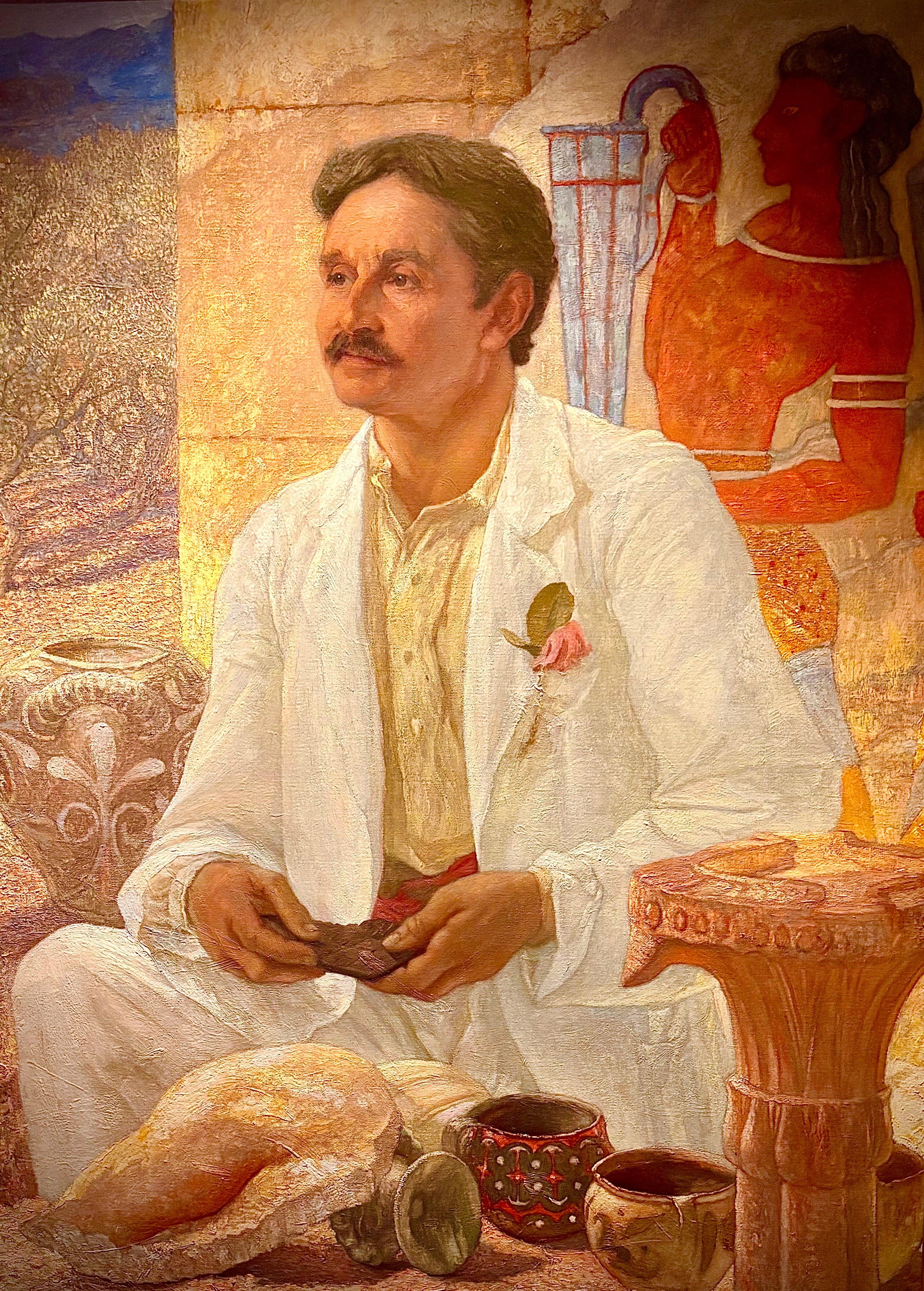
It wasn’t until a trip to an Athens bazaar, where Evans was shown some ancient Cretan ‘seal’ stones – once used to create signatures and identify goods – that something shifted in his brain from acquisitive interest to something more all-consuming. A year later, Evans bought twenty-one more seal stones and a gold signet ring “from Knossos” on Kephala Hill just outside Heraklion.
He was convinced that these stones displayed a new system of writing – and that if he was correct, they might just hold the key to an as-yet unknown European civilisation.
All but abandoning the Ashmolean, Evans began to negotiate with the authorities on Crete - just as the balance of power tipped from Ottoman to Greek rule. He wrangled with the owners of the Kephala hill - an overgrown mound of ruins in a mosquito-infested valley - and outwitted archaeologists from other countries who believed they had already secured an interest in the land.
Evans finally broke ground on 23rd March 1900, just days after buying the site.
From the outset, Knossos gave up amazing treasures. There were monumental walls and stairways, vivid patches of fresco paintings, intricate goddess figurines - and the oldest throne in Europe; a carved alabaster seat with a high, wave-shaped back. There were stout pots too - taller than a man, eggshell-thin ceramics, spectacular jewellery - including the ‘Ring of Minos’ a large, gold signet ring from a tomb close to the palace – and 3000 clay tablets bearing the strange writing that so intrigued him.
Evans, newly-widowed and emotionally shattered by the loss of his wife, Margaret, threw himself heart and soul into the excavation. With treasures being pulled out of the ground every minute, he filled notebooks with observations and sketches, travelled to give lectures, mounted exhibitions and developed the romantic story of a peaceful, artistic, bronze-age society. He dubbed this society ‘Minoan’ after the legendary King Minos - transforming legend into history at a stroke. His ideas proved popular with the press and his images of red-lipped women with tumbling curls, and bare-breasted snake goddesses, both shocked and seduced the world.
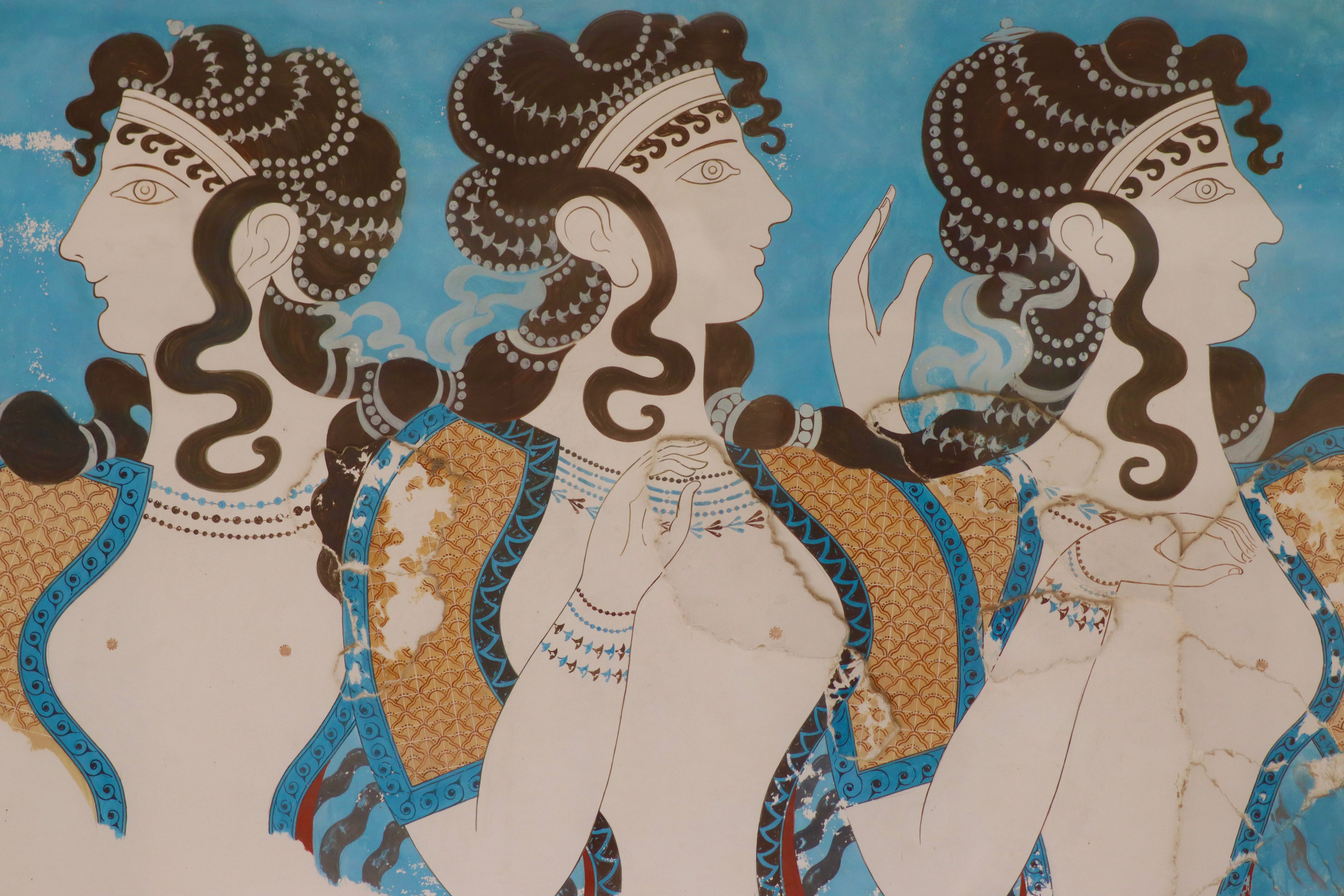
But Evans’ obsessive desire to prove the importance of Knossos also had a darker, more controversial side. When he returned to Crete for a second season of digging, he discovered that the Cretan winter had destroyed parts of his great project. Timber posts had disintegrated and water had carved a path of destruction through the site. Evans’ solution over the next two decades was to use architects and designers not just to protect the ruins, but to create the palace of his dreams. As building materials developed, iron girders and reinforced concrete were put to use, and Evans’ methods became the subject of intense academic argument.
Determined not to be held back by his critics, Evans heaped more and more of his own fortune into his vision, and even built a mansion above the site - the Villa Ariadne - so that he could be close to his work. Celebrities flocked to see the kingdom he was creating – and the contemporary artist and choreographer, Isadora Duncan, is said to have performed a dance in a semi-transparent tunic and bare feet on The Great Staircase.


On my visit today I’m dismayed that access to some areas of Knossos aren’t quite as I remember them. The throne room - red-walled, cool and still - in which you could walk and dream only five or six years ago, can now only be viewed from behind perspex barriers. The Great Staircase – the site of a murder in Patricia Highsmith’s famous thriller The Two Faces of January - is now a light well to peer into, rather than to walk or dance in - set aglow by the evening sun.


It’s always been impossible to move systematically from one part of this labyrinthine site to another - every space opens up into two more - yet now, the narrowed walkways and new dead ends make the place feel even more like a maze than ever.
But even with restricted access to protect this newly awarded UNESCO heritage site, Knossos could never truly disappoint. Despite the controversy too, Evans’ monumental buildings with their immense, russet pillars and colourful frescos of bull leaping, really do create a more immersive experience than at any other Minoan palace.
Today, it’s best to approach Knossos knowing that it is heavily framed by Evans’ obsessive imagination, and that modern scholarship is still questioning and interrogating the evidence. Weapons and armour have been found, along with grim traces of human sacrifice, shattering the myth of a peaceful society. Even the status of Knossos as a seat of royal power may not be entirely accurate. Perhaps this was a religious or political centre more like the monastic communities that spread throughout the island later - or a ceremonial space, echoed in the huge wedding tavernas that host whole villages during celebrations today?


Before I leave, I retrace my steps to the place where the bust of Cretan scholar, Minos Kalokairinos - who first persuaded archaeologists about the potential of the land at Kephala – stands facing Sir Arthur Evans. Evans is, I decide, eagle-faced, full of sharp edges, with a tense set to his jaw. I picture him scrawling in his notebooks behind me – writing himself out of the real world, into another place of imagination. I imagine him still stalking the corridors of Knossos , driven and isolated like the Minotaur of legend…
Because, for all his obsession - his money, his passion for this place - Evans never did manage to decode the strange writing of the Minoans. One of the languages remains undeciphered to this day -
But that’s another story…
‘Claire In Crete’ publishes new articles every two weeks about Crete’s people, history, culture, places, walks, wildlife, village life and more. It’s free to subscribe to receive each new post directly, and they’re all public, so do feel free to share.
If you like this article, you may also enjoy an earlier post about the forgotten female archaeologist, Harriet Boyd. I only found out about her, after an American Lady sat on my front doorstep and cried…
And if you like Claire in Crete, you may also enjoy my award-winning short story, Ann Hilder - a mystery inspired by the work of the artist LS Lowry and his shadowy ‘godchild’ Ann. The story is published as a small paperback book and as an ebook on Amazon at https://amzn.eu/d/bMidwmh
Thank you for reading!